
X-ray and radiography simulators
Positioning, exposure factors and image critique without radiation: the types of radiography simulator, what they teach, the evidence, and the rules for teaching X-ray in India.
By the ScanFlo Editorial Team · Updated
In this section · Simulation
An X-ray positioning or radiography simulator lets students position a virtual patient, choose the detector, collimate, set kV, mAs and source-to-image distance, then expose and judge the image, all without radiation. It ranges from software and VR to physical phantoms and role-play, and it is used to prepare students for clinical placements, not to replace them.
Sources: Sapkaroski et al. (2019); Shanahan et al. (2021); Bridge et al. (2021); England et al., EMJ Radiology.
What kinds of radiography simulator are there?
Six kinds, from a classmate playing the patient to fully integrated software.
Simulator types in diagnostic radiography
That list follows the categories in a 2026 review in EMJ Radiology, which names part-task trainers, simulated patients, simulated environments, VR and haptic systems, computer-based simulators and integrated simulators (England, Rainey, McLaughlin and McEntee).
What does an X-ray simulator teach?
Positioning, exposure factors, image critique and radiation protection, with the freedom to get it wrong and see why.
What students said virtual radiography improved
Simulation also lets teachers show what bad practice looks like. Developers of one open-source X-ray simulator note it lets lecturers "show their students the results of good and bad practices in a classroom environment, avoiding radiation risk"; 72% of 18 professionals they surveyed found the images visually realistic (Sujar et al., 2021).
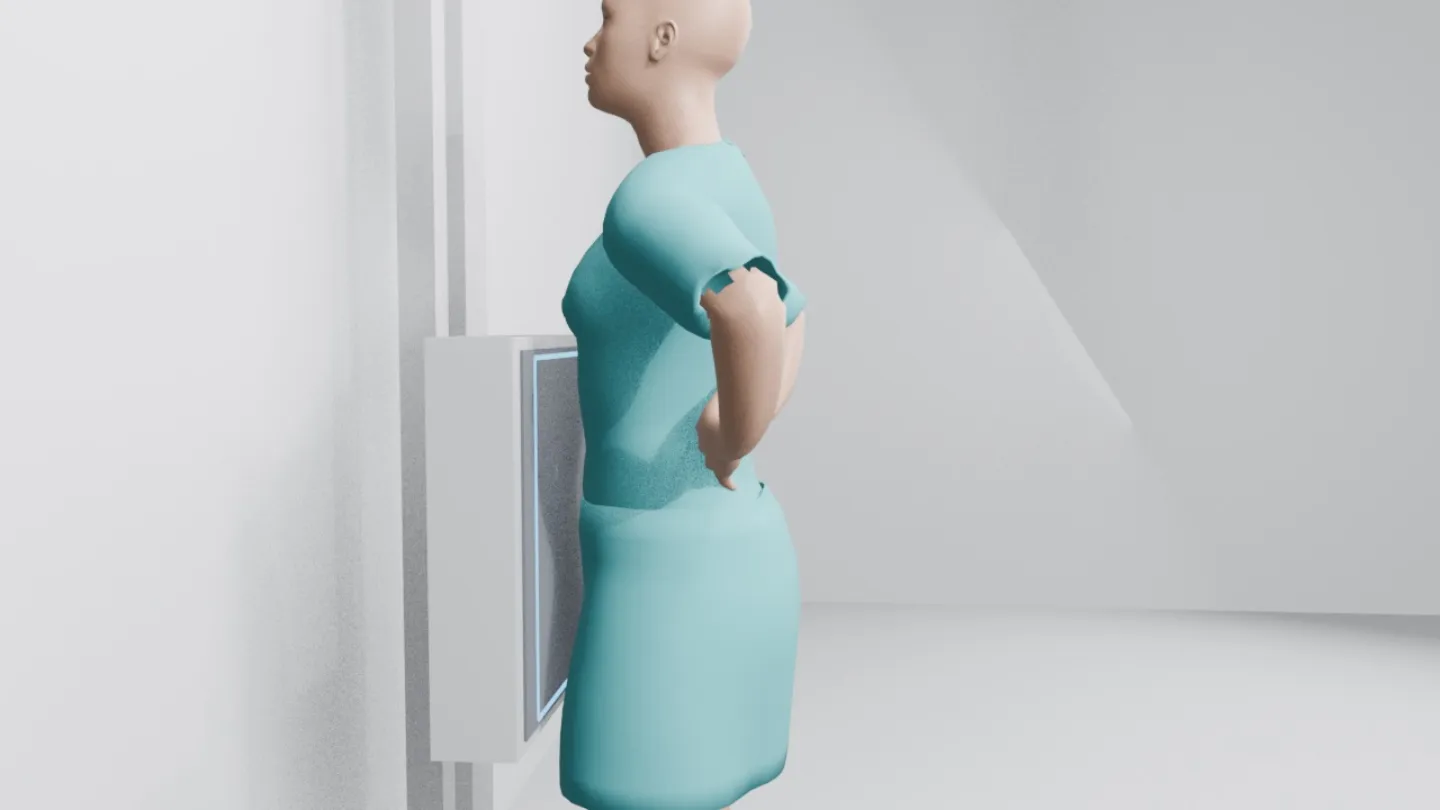
ScanFlo XR · positioning
Does radiography simulation work?
For positioning and confidence, yes, with the caution that studies are small and varied.
VR-trained vs role-play-trained students, hand positioning, tested 3 weeks later
A literature review by Nick Shiner of the University of Derby, covering 15 articles, concluded that simulation "is a valuable pedagogical approach for diagnostic radiography education", with confidence and understanding of professional roles as common outcomes (Shiner, Radiography, 2018). A 2024 systematic review of 17 studies found VR "significantly more effective than traditional methods" for radiographic skills, while warning the studies were too varied for a firm recommendation (Shetty et al., JMIR Medical Education, 2024).
Despite this, many would argue that simulation is a supplementary tool and not a direct replacement for experience with patients.
Can simulation replace clinical placement?
A small part of it, according to the evidence and expert opinion so far.
| Finding | Source |
|---|---|
| Experts thought 11–30% of clinical training time could be replaced by simulated placement | EMJ Radiology review |
| A one-week simulation package was a suitable replacement for one week of placement | Partner et al., 2022 |
| Evidence for clinical replacement comes from small student samples | Jimenez et al., 2023 |
| Ireland's regulator cut required placement hours from 1,200 to 1,000 | EMJ Radiology review |
| The UK supports about 120 hours of simulation alongside placements, without a mandate | Bradford report for the College of Radiographers, 2025 |
| Most programmes reported up to 100 hours of simulation per student per year | Bridge et al., 2021 |
Radiation rules for teaching X-ray in India
A software simulator involves no radiation. An energised teaching room does, and AERB's rules apply.
AERB's safety guide on X-ray equipment used for research and education sets dose limits of 6 mSv a year for trainees aged 16 to 18 and occupational limits for older students, and permits trainees to use equipment "only under the direct supervision of an identified trained person" (AERB/RF/SG/XGE, 2025). That guide covers educational and research equipment rather than medical diagnostic units, so check the medical code for a clinical teaching room.
What to look for in a radiography simulator
Try it on the console
Explore ScanFlo XR
Position the patient in a 3D X-ray room, choose the detector, collimate, set kV, mAs and SID, expose, then read and film the image.
See ScanFlo XR →Related: X-ray positioning guides, the radiography simulation guide, and whether simulator practice transfers.
Frequently asked questions
Can a radiography simulator replace clinical placement?
Partly, at most. Experts surveyed in one study thought 11 to 30% of clinical training time could be replaced by simulated placement, and one UK package was judged a suitable replacement for one week. Most authors treat simulation as a supplement to patient experience, not a substitute.
Is a phantom a simulator?
A phantom is a physical part-task trainer: a body part made of tissue-equivalent material that you can X-ray. It teaches real exposures but needs an energised room. A software simulator teaches positioning and exposure choices with no radiation at all.
Do students need to wear a dosimeter on a simulator?
No, a software simulator produces no radiation. In an energised teaching room the rules change: AERB's guidance on X-ray equipment used in education sets a 6 mSv a year limit for trainees aged 16 to 18 and occupational limits for those older, and requires direct supervision.
How many hours of simulation should a radiography programme include?
The UK simulation model report supports about 120 hours of simulation-based education across a programme, alongside placement hours, and advises against making it a mandate. An international audit found most programmes reported up to 100 hours per student per year.
Is VR better than a screen-based simulator?
A 2024 systematic review found VR more effective than traditional teaching for radiographic skills, but called the studies too varied for a firm recommendation. A screen-based simulator is cheaper, runs on existing computers and covers the same decisions.
Sources
Every figure on this page links back to one of these.
- Shiner N. Is there a role for simulation based education within conventional diagnostic radiography? A literature review. Radiography, 2018
- Sapkaroski D, et al. Quantification of student radiographic patient positioning using an immersive virtual reality simulation. Simulation in Healthcare, 2019
- Sapkaroski D, et al. The implementation of a haptic feedback virtual reality simulation clinic with dynamic patient interaction and communication for medical imaging students. JMRS, 2018
- Shetty S, et al. The scope of virtual reality simulators in radiology education: systematic literature review. JMIR Medical Education, 2024
- Bridge P, et al. International audit of simulation use in pre-registration medical radiation science training. Radiography, 2021
- Shanahan M, Molyneux T, Vindigni D. Chiropractic students' experiences on the use of virtual radiography simulation: a pilot observational study. BMC Medical Education, 2021
- Sujar A, et al. Interactive teaching environment for diagnostic radiography with real-time X-ray simulation and patient positioning, 2021
- Partner A, et al. First year student radiographers' perceptions of a one-week simulation-based education package. Radiography, 2022
- England A, Rainey C, McLaughlin L, McEntee M. Simulation in diagnostic radiography training: a replacement for clinical placements? EMJ Radiology
- Wilkinson E, et al. The role and efficacy of simulation in pre-registration education and training of diagnostic radiographers. University of Bradford, 2025
- Jimenez YA, et al. Can simulation-based education or other education interventions replace clinical placement in medical radiation sciences? Radiography, 2023
- AERB. Safety guide AERB/RF/SG/XGE: X-ray generating equipment for research, education, inspection and analysis, 2025