
AI image enhancement
Deep-learning reconstruction: less noise, more detail, same acquisition.
Vendor consoles give it different names, but the principle is the same: a trained network denoises and sharpens the reconstruction so a faster or lower-dose acquisition reads like a longer one. ScanFlo lets learners switch it on and off and see exactly what it buys, and what it cannot.
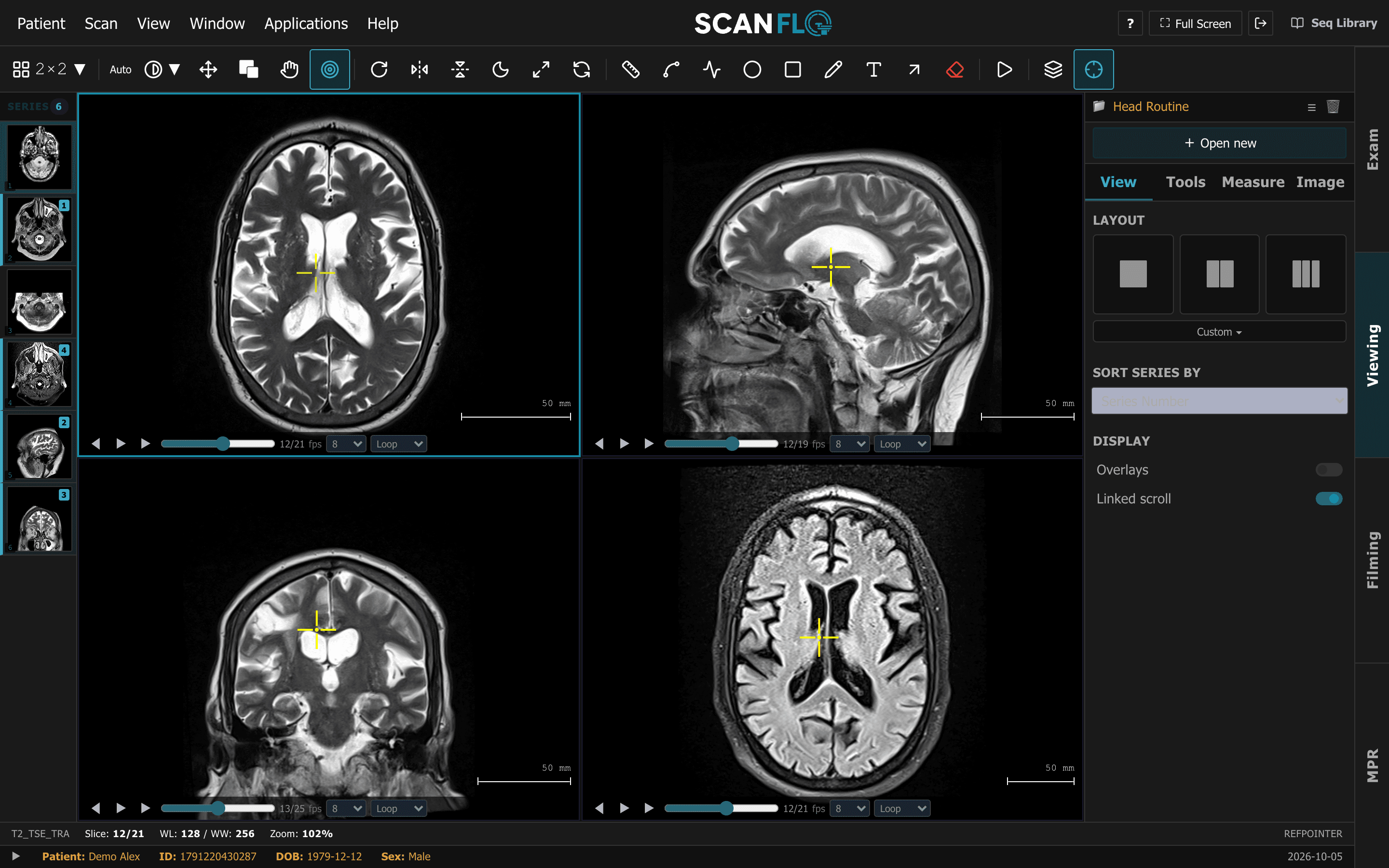
How it works
Three steps, on a real console workflow.
Scan at the trade-off
Cut the averages, shorten the scan or lower the mAs. Acquire the noisy version on purpose.
Reconstruct with enhancement
Apply deep-learning denoising and resolution enhancement to the same raw acquisition and compare side by side.
Judge what changed
Look at SNR, apparent resolution and texture, and at the limits. Enhancement cannot invent anatomy the acquisition never captured.
What learners compare
| Setting | Effect | What it teaches |
|---|---|---|
| Denoising strength | Lower noise at the same scan time | Where SNR comes from and what it costs |
| Resolution enhancement | Sharper edges from the same matrix | Apparent vs. acquired resolution |
| Off vs. on | Same raw data, two reconstructions | Enhancement is a reconstruction choice, not a sequence |
| Dose / time saved | Equivalent quality at lower input | How AI reconstruction changes protocol design |
In the classroom
How programs use it
- Run the same case with enhancement on and off and have learners write what is real and what is smoothed.
- Combine with dose training: find the lowest mAs that still reads acceptably with enhancement.
- Discuss the department policy question: when is an AI-reconstructed image the record of truth?
Learn the concepts
Short guides that pair with this feature:
Start today
Put your learners at the console today.
Free 45-minute trial. No installs. Runs in any browser.