
PET-CT simulators for technologist training
The PET-CT exam without a tracer or a scanner: preparation, uptake, bed planning, CT-AC, fused reading and SUV. How training simulators differ from Monte Carlo research tools.
By the ScanFlo Editorial Team · Updated
In this section · Simulation
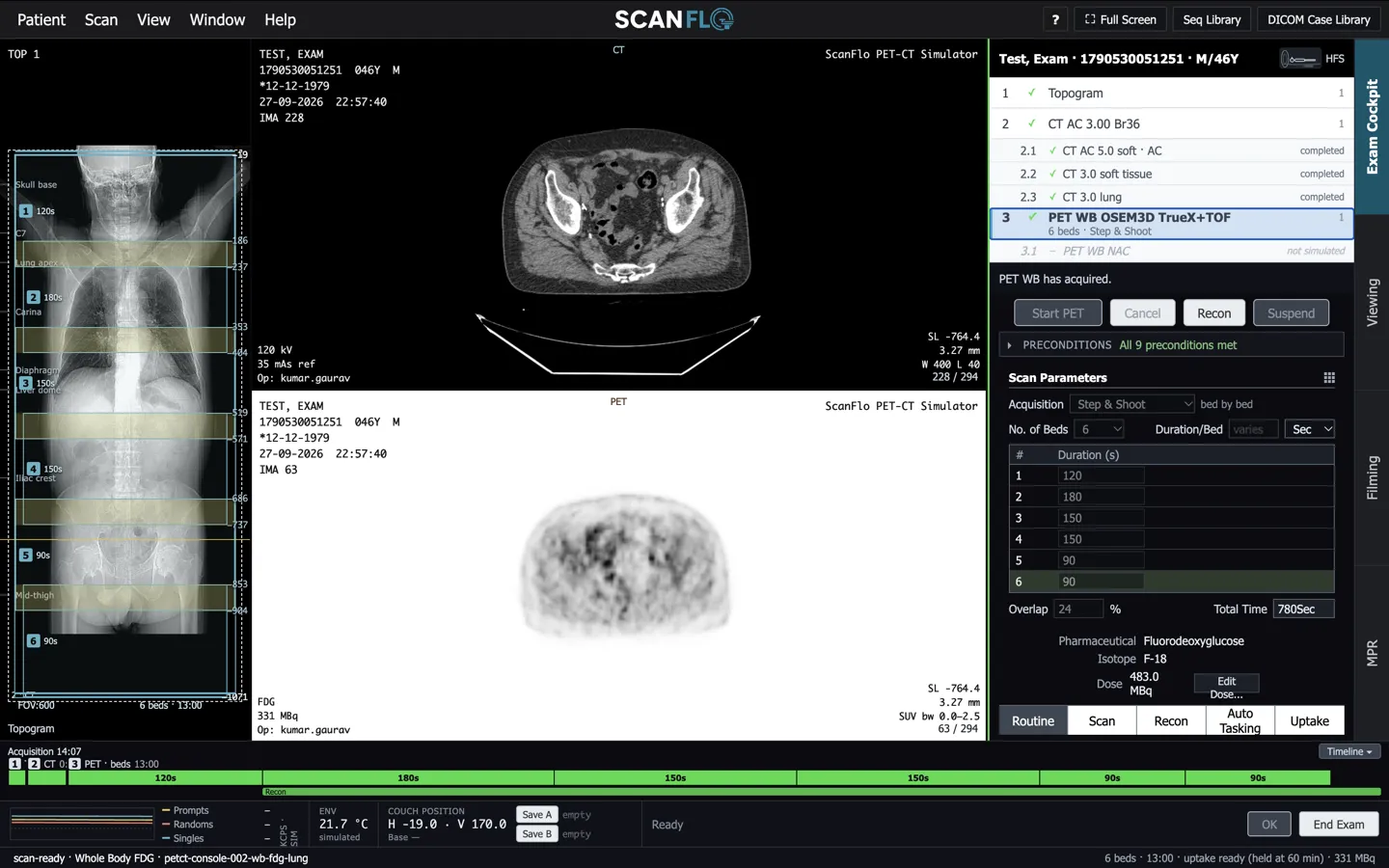
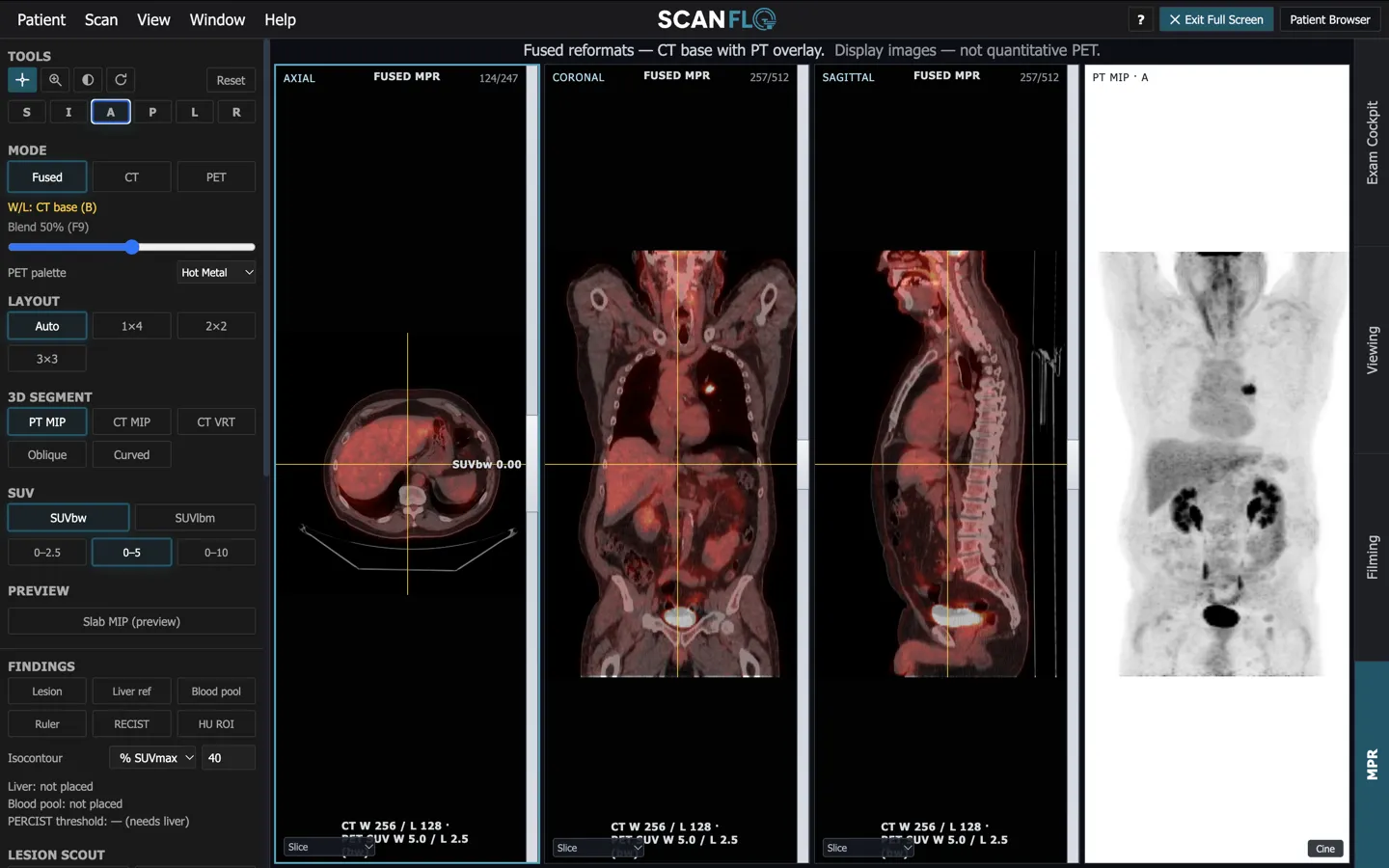
A PET-CT simulator for technologist training reproduces the hybrid exam without a tracer or a scanner. You register the patient's weight, height, blood glucose and injected activity, watch the uptake clock, plan the PET beds and the attenuation-correction CT on one topogram, run the acquisition, then read the fused images and measure SUV. It is different from the Monte Carlo simulators physicists use to design scanners.
Sources: EANM guideline v2.0 (2015); Singh et al. (2023); Li et al. (2020).
Training simulator or Monte Carlo simulator?
Search for "PET-CT simulator" and you mostly find research physics. Technologists need something else.
Two meanings of 'PET-CT simulator'
OpenGATE describes Monte Carlo simulation as "an essential tool in emission tomography to assist in the design of new medical imaging devices" and to optimise scan protocols (OpenGATE documentation). It is the right tool for a physicist and the wrong one for a technologist learning to run a list.
What does a PET-CT simulator teach?
Every step where a technologist's choice changes the result, most of them before the scanner starts.
An FDG PET-CT exam, step by step
- STEP 01PrepareAt least 4 hours fasting; blood glucose checked; weight measured on the day.
- STEP 02InjectActivity scaled to weight and bed time; patient kept warm and quiet.
- STEP 03Uptake60 minutes, acceptable 55–75, kept the same between scans.
- STEP 04PlanTopogram; PET beds from skull base to mid-thigh; arms up.
- STEP 05CT-AC then PETLow-dose CT for attenuation correction, then the PET beds.
- STEP 06Read and measureFused images; SUV or SUL in a volume of interest.
| Item | EANM guideline v2.0 |
|---|---|
| Fasting | At least 4 hours, plain water only |
| Blood glucose | Proceed below 11 mmol/L (about 200 mg/dL); otherwise reschedule or exclude |
| Uptake time | 60 minutes, acceptable range 55–75 |
| Activity | Scaled to weight and acquisition time per bed; for patients over 90 kg, lengthen bed time rather than raise activity |
| Coverage | Skull base to mid-thigh for most oncology indications |
| F-18 half-life | 109.7 minutes |
The guideline makes the point that matters most for SUV: its consistency "depends on strict observance of the uptake time" (Boellaard et al., EANM, 2015). A simulator that runs the uptake clock and recomputes SUV from what was entered at the desk makes that lesson hard to forget.
ScanFlo PET-CT · exam cockpit
Why PET-CT training matters in India
The number of scanners has grown fast, from three in 2005 to 359 by 2023, and each needs trained technologists.
PET-CT scanners in India
Globally the gap is wide. An IAEA-led analysis estimated that one PET-CT scanner serves about 601,000 people in high-income countries and 10 million in lower-middle-income countries (Gallach et al., 2020). In India, AERB's licensing rules require trained radiation workers to run a nuclear medicine facility, and in February 2026 AERB said its assessment of nuclear medicine technologist courses had been discontinued, following communication from NCAHP (AERB, 2026).
Radiation dose for the technologist
PET-CT technologists receive most of their department's staff dose, and patient positioning is the biggest single source.
The survey results revealed that the on-campus practical training using simulators deepened students' understanding of the content they had encountered in classroom lectures.
ScanFlo PET-CT · fused reading
What to look for in PET-CT training software
Try it on the console
See the PET-CT simulator
ScanFlo PET-CT runs the exam from registration and uptake to fused reading and SUV, in a browser, on real DICOM cases.
See ScanFlo PET-CT →Related: how PET-CT works, PET-CT acquisition types, and radiotracers.
Frequently asked questions
Is a PET-CT simulator the same as a Monte Carlo PET simulator?
No. Monte Carlo tools such as GATE model photon physics to design scanners, test reconstruction algorithms and optimise protocols; they are research software. A PET-CT training simulator reproduces the technologist's exam workflow, from patient preparation to SUV.
How long is the FDG uptake period?
The EANM guideline recommends 60 minutes, with an acceptable range of 55 to 75 minutes, and stresses that SUV consistency depends on keeping that time constant between scans.
What blood glucose is too high for an FDG PET-CT?
Under the EANM guideline, the study can go ahead below 11 mmol/L (about 200 mg/dL). At or above that level it should be rescheduled or the patient excluded, depending on the circumstances.
Who regulates nuclear medicine technologist courses in India?
AERB announced in February 2026 that, following communication from NCAHP, its assessment of nuclear medicine technologist courses has been discontinued. Course recognition now sits with NCAHP; check a course's current status before enrolling.
Can a simulator reduce a technologist's radiation dose?
Indirectly. Positioning is the largest source of occupational dose in PET-CT, so a technologist who has rehearsed the workflow and spends less time beside an injected patient is exposed less. The simulator itself involves no radiation.
Sources
Every figure on this page links back to one of these.
- Boellaard R, et al. FDG PET/CT: EANM procedure guidelines for tumour imaging, version 2.0. EJNMMI, 2015
- Shinto AS. An overview of nuclear medicine and PET CT in India. Current Trends in Clinical and Medical Imaging, 2017
- Sharma AR. Nuclear medicine in India: a historical journey. Indian Journal of Nuclear Medicine, 2018
- Singh B, et al. India's growing nuclear medicine infrastructure and emergence of radiotheranostics in cancer care. Indian Journal of Nuclear Medicine, 2023
- Gallach M, et al. Addressing global inequities in PET-CT for cancer management. Medical Science Monitor, 2020
- AERB. Notice on assessment of nuclear medicine technologist courses, February 2026
- AERB. Regulatory requirements and guidelines for new nuclear medicine facility
- AERB. Radiation protection principles and dose limits
- Nagamoto K, et al. Optimizing radiation protection in PET/CT examinations: reducing occupational exposure during patient positioning. Cureus, 2024
- Li W, Fang L, Li J. Exposure doses to technologists working in 7 PET/CT departments. Dose-Response, 2020
- Roberts FO, et al. Radiation dose to PET technologists and strategies to lower occupational exposure. Journal of Nuclear Medicine Technology
- Nakaya K, et al. Simulator education initiatives for on-campus practical training in nuclear medicine technology. JNMT, 2024
- OpenGATE. Introduction