
Assessing student scanning skills objectively: OSCE stations and rubrics
ScanFlo Editorial Team · · 8 min read
In this article
- What is an OSCE, and why use it for radiography?
- How is an OSCE different from spotters and a viva?
- Which scanning skills make good stations?
- Checklist or global rating scale?
- How many stations do you need for a reliable score?
- Can a simulator be an OSCE station?
- How do you run an OSCE for a batch of twenty?
You assess scanning skills objectively with an OSCE: a timed circuit of stations, each with one task and a pre-agreed key-list, so every student does the same thing and is marked the same way. For radiography that means stations for positioning, protocol choice, safety screening, image critique and patient communication.
The traditional practical, spotters plus a viva, mostly rewards memory and confidence in conversation. It also depends heavily on which examiner a student draws. An OSCE fixes both problems, and it is not new: Harden and colleagues described it in 1975.
What is an OSCE, and why use it for radiography?
A multi-station exam where each station tests one skill against a fixed key-list, so the result depends on the student rather than the examiner.
The examination is more objective and a marking strategy can be decided in advance.
It works for radiographers. A study of student radiographers found OSCE marks correlated significantly with their marks across all three years of the programme, and called it a manageable form of assessment
(Marshall and Harris, Radiography). Writing for the National Board of Examinations in 2010, Agarwal and colleagues argued for OSCE in radiology practical exams in India (IJRI, 2010).
How is an OSCE different from spotters and a viva?
It keeps the same ingredients but standardises them: every station is timed, scripted and marked against a list agreed in advance.
Spotters and viva
- Questions vary from student to student
- Marks depend on the examiner's judgement on the day
- Tests recall more than doing
- Hard to compare across batches
OSCE
- Same task and time for every student
- Pre-agreed key-list for each station
- Tests what students do, at a console or with a patient
- Scores comparable across examiners and years
The NCAHP-based MRIT curriculum describes the practical exam as spotters, demonstration of equipment handling and case-based discussions, with 50% needed separately in theory and practical (NCAHP curriculum, Gurugram University edition). An OSCE is a fair way to run all three.
Which scanning skills make good stations?
Anything a student must do on day one of a job: positioning, protocol choice, safety screening, communication, image critique and planning on a console.
Checklist or global rating scale?
Use both. Checklists and global ratings are about equally consistent between examiners, but global ratings hold up better across stations and capture expertise.
In practice the examiner ticks the key-list steps and then gives one overall rating from 1 to 5. The checklist makes marking consistent. The rating catches the student who did every step but in an order that would have frightened a patient.
| Step | Done | Critical |
|---|---|---|
| Chooses sagittal T2 for the clinical question | ☐ | |
| Slice group covers T12 to S1 and both foramina | ☐ | Yes |
| Slices parallel to the cord on the coronal localizer | ☐ | |
| Phase direction set to avoid wrap | ☐ | |
| Scan time within the department limit | ☐ | |
| Overall rating, 1 (unsafe) to 5 (independent) | 1 · 2 · 3 · 4 · 5 |
How many stations do you need for a reliable score?
More than you think. A meta-analysis found reliability across stations averaged 0.66, and it rose with more stations and more examiners per station.
Brannick and colleagues pooled OSCE reliability studies and found that better-than-average reliability went with a greater number of stations and a higher number of examiners per station
. They also warned that communication skills are harder to assess reliably than clinical ones (Brannick and colleagues, Medical Education, 2011). Twelve short stations beat six long ones.
Can a simulator be an OSCE station?
Yes. A software station gives every student the same patient and records exactly what they did, which makes marking easier and fairer.
Researchers already use OSCEs to measure simulator training. In a study of 188 first-year students, both the VR-trained and physically trained groups were assessed in an OSCE using actors as patients (Rowe and colleagues, 2023). In China, a teaching reform in medical imaging technology assessed hands-on skills with an OSCE-style station exam and reported practical scores of 92.1 against 82.4 (Qi and Zhou, Frontiers in Medicine, 2026). The UK's simulation model report notes that simulation for assessment needs more study (Bradford, 2025), so treat a simulator station as one station among several.
How do you run an OSCE for a batch of twenty?
With five-minute stations, about ten students go round in two hours, so a batch of twenty needs two circuits or one afternoon.
Try it on the console
Run console stations for the whole batch
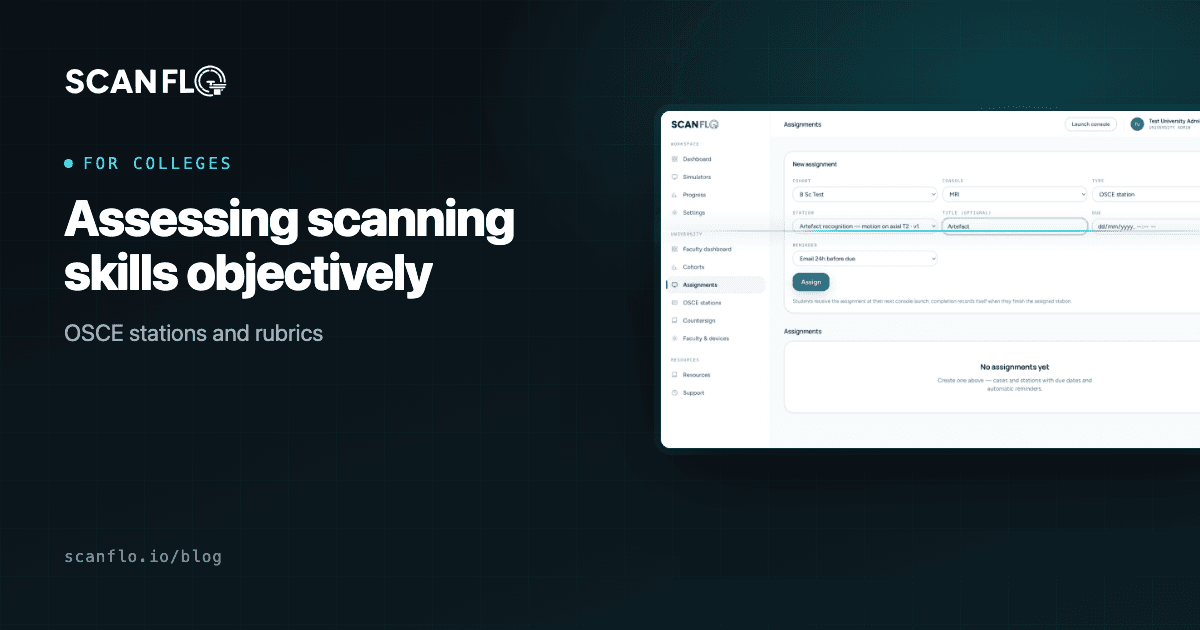
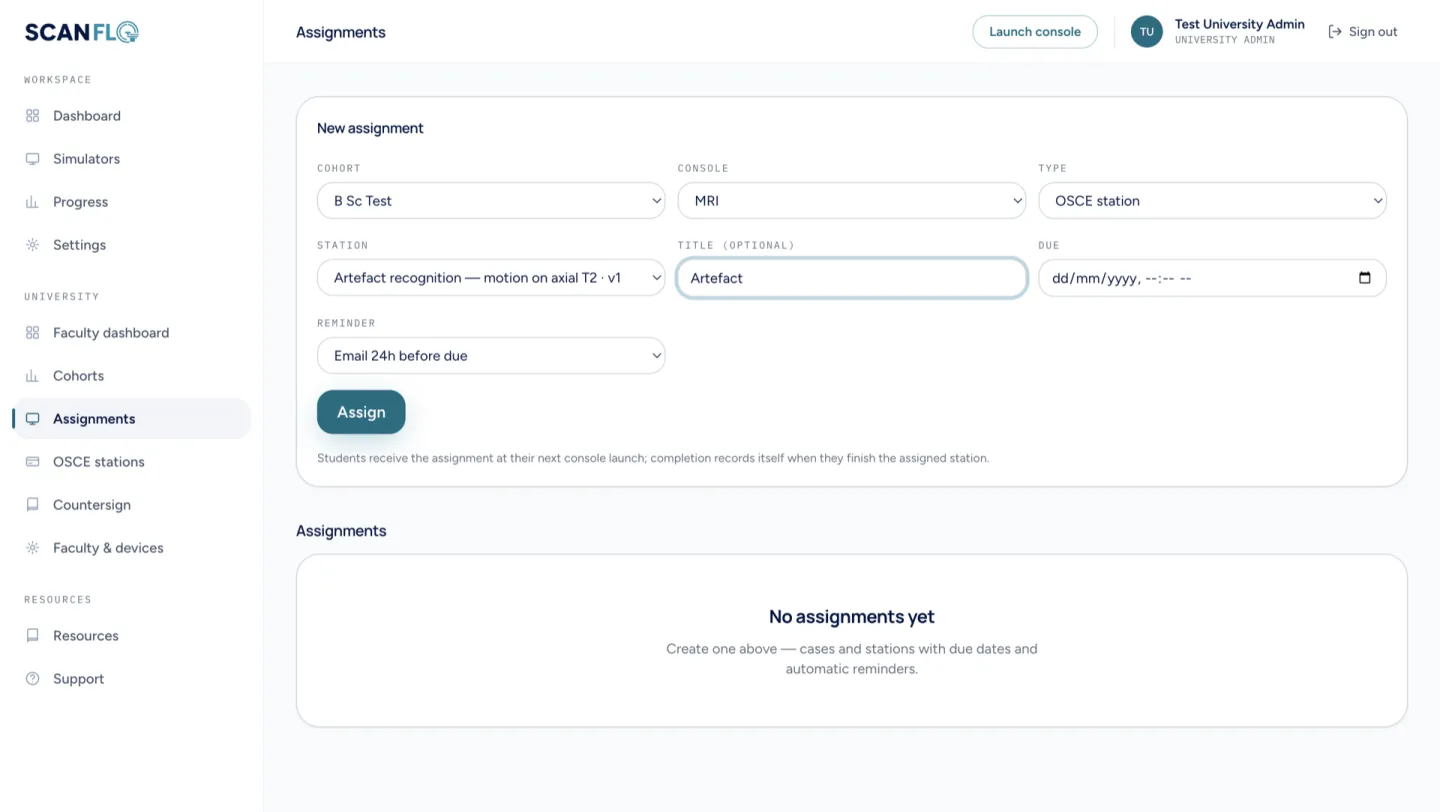
ScanFlo lets faculty assign the same MRI or CT station to every student and see who completed it. Pair it with your manned stations.
See ScanFlo for colleges →Related: teaching MRI without scanner time, building a radiography lab on a budget, and whether simulator practice transfers to the scanner.
Sources
Every figure in this article links back to one of these.
- Harden RM, Stevenson M, Downie WW, Wilson GM. Assessment of clinical competence using objective structured examination. BMJ, 1975;1(5955):447-51
- Marshall G, Harris P. A study of the role of an objective structured clinical examination (OSCE) in assessing clinical competence in third year student radiographers. Radiography
- Agarwal A, et al. Objective structured clinical examination in radiology. Indian Journal of Radiology and Imaging, 2010;20(2):83-8
- Brannick MT, Erol-Korkmaz HT, Prewett M. A systematic review of the reliability of objective structured clinical examination scores. Medical Education, 2011;45(12):1181-9
- Ilgen JS, Ma IW, Hatala R, Cook DA. A systematic review of validity evidence for checklists versus global rating scales in simulation-based assessment. Medical Education, 2015;49(2):161-73
- Rowe D, Garcia A, Rossi B. Comparison of virtual reality and physical simulation training in first-year radiography students in South America. JMRS, 2023;70(2)
- Qi C, Zhou S. Competency-based, multicomponent teaching reform in medical imaging technology: a quasi-experimental study. Frontiers in Medicine, 2026
- NCAHP competency-based curriculum, Bachelor of Medical Radiology and Imaging Technology (Gurugram University edition)
- Wilkinson E, et al. The role and efficacy of simulation in pre-registration education and training of diagnostic radiographers. University of Bradford, 2025
Frequently asked questions
Is OSCE mandatory in the NCAHP MRIT curriculum?
The curriculum text we read describes practical exams as spotters, demonstration of equipment handling and case-based discussions, and requires 50% separately in theory and practical. It does not name OSCE, but an OSCE is a structured way to run exactly those elements.
What is the difference between OSCE and OSPE?
OSPE, the objective structured practical examination, uses the same station format for laboratory and practical skills rather than clinical encounters. In radiography the two overlap, and many colleges use the terms interchangeably.
Can an OSCE be used for practice rather than a final exam?
Yes, and it should be. A formative OSCE mid-semester shows students exactly what the final will ask and gives faculty a chance to pilot stations before they count.
How do we write a key-list for an MRI protocol station?
List the observable steps in order: correct sequence chosen for the clinical question, slice group covers the anatomy, orientation and angle correct, phase direction sensible, scan time within the department's limit, safety check done. Each step is marked done or not done.
What pass mark should a station use?
Set it in advance with the examiners, based on what a safe newly qualified technologist must do. Some steps, such as screening before Zone IV, should be critical: missing them fails the station whatever the total.