
CT protocol library
From scout to helical to HRCT: protocol families that behave.
Head routine, chest, abdomen and high-resolution lung. Each protocol carries real acquisition parameters, and every choice shows up in image quality and dose.
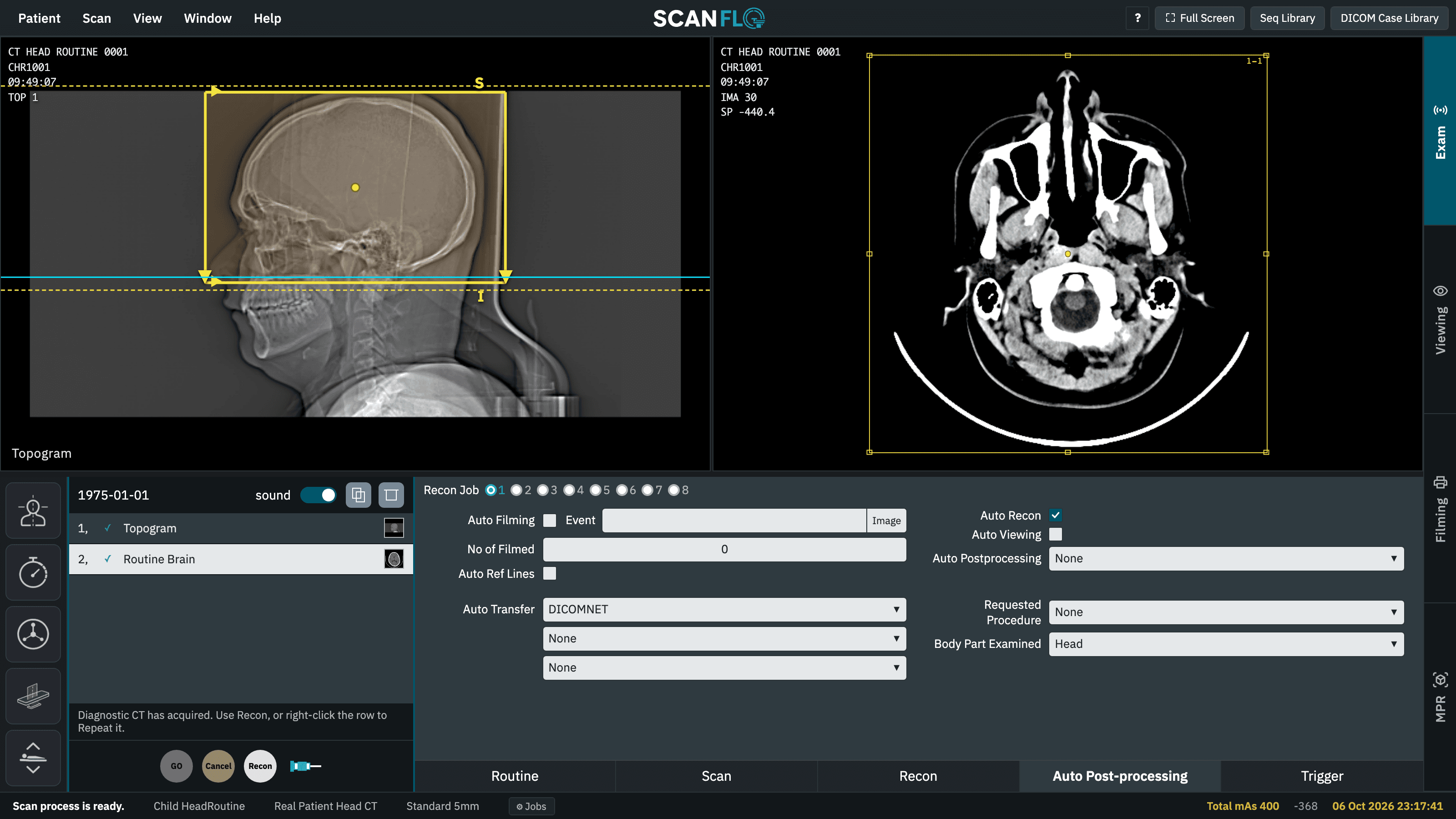
How it works
Three steps, on a real console workflow.
01
Start with the scout
Plan the scan range on the topogram. Range discipline is dose discipline, and the DLP readout grades it.
02
Set the acquisition
kVp, mAs, pitch, rotation time and collimation: the parameters a CT technologist actually owns.
03
Reconstruct and judge
Same raw data, different kernels and windows. Learners see why one acquisition becomes three different reads.
Protocol parameters
| Parameter | Range | Consequence |
|---|---|---|
| kVp | 80–140 | Contrast and dose |
| mAs | 20–400 | Noise vs dose, visibly |
| Pitch | 0.5–1.5 | Coverage speed vs quality |
| Kernel | Soft → sharp | The radiologist's read |
In the classroom
How programs use it
- Protocol translation exercises: take a department protocol card, reproduce it.
- HRCT as a distinct skill: thin slices, sharp kernel, lung windows.
- Compare two pitches at fixed dose. Where did the quality go?
Learn the concepts
Short guides that pair with this feature:
Start today
Put your learners at the console today.
Free 45-minute trial. No installs. Runs in any browser.