
Radiographer resume: the sections, the CARE method and a sample
ScanFlo Editorial Team · · 10 min read
In this article
- Which sections should a radiographer resume have?
- What is the CARE method for resume bullets?
- How do you write the Technical Skills section?
- Which certifications count for radiographers in India?
- Photo, date of birth, length: what changes by country?
- How do you show soft skills?
- A sample radiographer resume
A strong radiographer resume has six sections, in this order: Education, Work Experience, Projects, Certifications, Technical Skills and Soft Skills. Every bullet should show what changed because of you. The CARE method does that: the Context, the Action you took, the Result, and the Effect, meaning the difference it made.
Recruiters reading radiographer CVs see the same line again and again: performed MRI and CT scans as per protocol. It describes the job, not the person. This guide shows how to fill each section so yours describes you, and ends with a full sample you can download.
Which sections should a radiographer resume have?
Contact details and a two-line profile at the top, then Education, Work Experience, Projects, Certifications, Technical Skills and Soft Skills.
Freshers can move Projects above Work Experience when the internship is their only experience. An audit you ran in your MRI posting says more than a list of departments you rotated through.
What is the CARE method for resume bullets?
CARE stands for Context, Action, Result and Effect. It extends the standard CAR method with the step most bullets leave out: the difference your work made.
| Method | Parts | Taught by |
|---|---|---|
| CAR | Context, Action, Result | Santa Clara University |
| STAR | Situation, Task, Action, Result | Western Governors University |
| STARE | STAR plus Evaluation | Sheffield Hallam University |
| CARE | CAR plus Effect: the difference you made | This guide |
How do you write the Technical Skills section?
Group it by modality and name what you have actually run: field strengths, slice counts, protocols, systems and safety procedures.
Tailor it for each job. Radiography educators Jo McNamara and Kerry Mills warn: Be careful with copying and pasting if you are applying for multiple jobs. You may refer to equipment or software that varies between departments.
(SoR Starting Out).
Which certifications count for radiographers in India?
Your recognised degree, NCAHP registration as it opens, BLS or ACLS, and documented MR safety training. A Radiological Safety Officer role comes later and has its own rules.
| Credential | What to know | Source |
|---|---|---|
| NCAHP registration | The commission lists MRI and CT technologists among its professions and has published 2026 registration regulations. | NCAHP |
| BLS / ACLS | American Heart Association cards are valid for two years; list the expiry date. | AHA |
| MR safety training | Hospital-defined; usually renewed every year. List the level and date. | Your department |
| RSO at a CT or IR facility | Open to an X-ray technologist with three years of CT or IR experience, approved by AERB. | AERB |
| HCPC (UK only) | International route for radiographers trained outside the UK. | HCPC |
A common mistake
Photo, date of birth, length: what changes by country?
Leave the photo and date of birth off UK and US CVs. Gulf employers commonly expect a photo. Indian government applications ask for photos and date-of-birth proof as separate documents.
| Destination | Photo | Date of birth | Length |
|---|---|---|---|
| United Kingdom | No (Prospects) | No (National Careers Service) | Two pages at most |
| United States | No (Pomona College) | No | One to two pages |
| Gulf | Usually expected (LoopCV, commercial guide) | Often included | Two pages common |
| India, government posts | Attached separately (AIIMS notice) | Proof attached | As per the form |
For NHS jobs the CV is only part of it. Shortlisting is made against the person specification, and one trust tells applicants not to write "covered above" (NHS trust applicant notes). Use the words of the job advert.
How do you show soft skills?
Name two or three, and give each one a piece of evidence.
Radiography is a profession that requires strong technical skills, and these are essential. However, over the years, I have come to realise that those with a positive and proactive, can-do attitude are far more likely to shape their career paths than those who rely on technical ability alone.
A sample radiographer resume
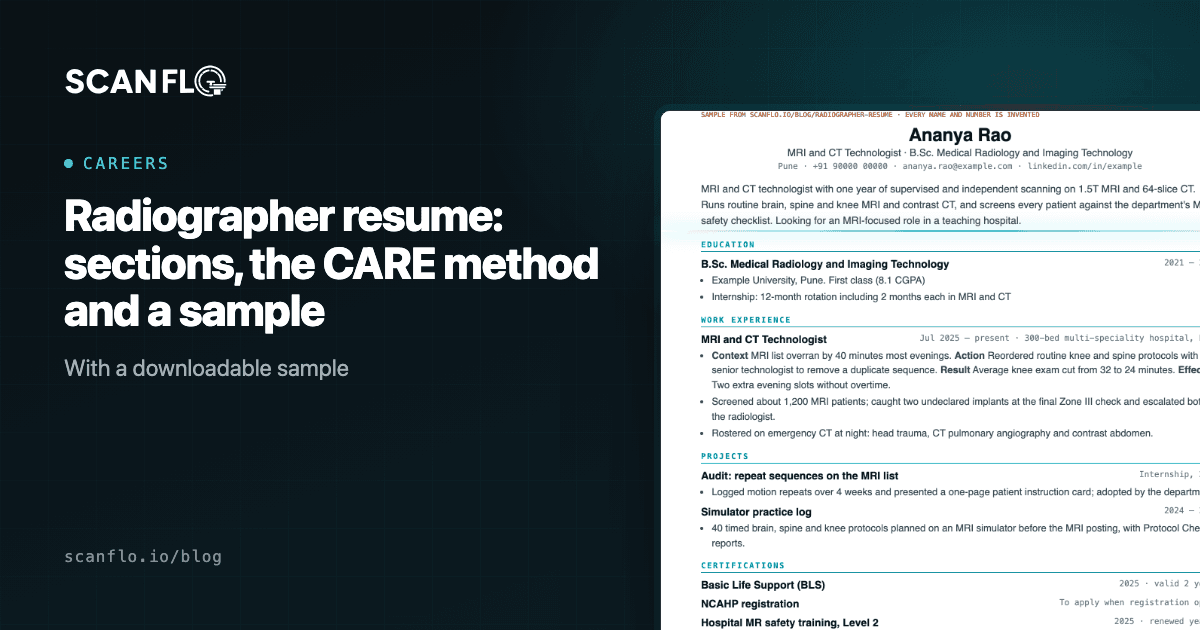
Below is a complete one-page example for an MRI and CT technologist with one year of experience, using every section and one full CARE bullet.
MRI and CT technologist with one year of supervised and independent scanning on 1.5T MRI and 64-slice CT. Runs routine brain, spine and knee MRI and contrast CT, and screens every patient against the department's MR safety checklist. Looking for an MRI-focused role in a teaching hospital.
- Example University, Pune. First class (8.1 CGPA)
- Internship: 12-month rotation including 2 months each in MRI and CT
- Context MRI list overran by 40 minutes most evenings. Action Reordered routine knee and spine protocols with the senior technologist to remove a duplicate sequence. Result Average knee exam cut from 32 to 24 minutes. Effect Two extra evening slots without overtime.
- Screened about 1,200 MRI patients; caught two undeclared implants at the final Zone III check and escalated both to the radiologist.
- Rostered on emergency CT at night: head trauma, CT pulmonary angiography and contrast abdomen.
- Logged motion repeats over 4 weeks and presented a one-page patient instruction card; adopted by the department.
- 40 timed brain, spine and knee protocols planned on an MRI simulator before the MRI posting, with Protocol Check reports.
Try it on the console
Give your Projects section something real
Plan and time brain, spine and knee protocols on ScanFlo MRI, and keep the Protocol Check reports as evidence for your CV and interview.
Start free →Next step: MRI technologist interview questions, with answers. Related: working abroad as a radiographer.
Sources
Every figure in this article links back to one of these.
- Santa Clara University Career Center. Accomplishment statements
- Western Governors University. Accomplishment statements
- Sheffield Hallam University. STARE
- Prospects. How to write a CV
- National Careers Service. CV sections
- Pomona College. US resume tips for international students
- LoopCV. Gulf CV format (commercial guide)
- AIIMS New Delhi. Radiographer recruitment notice, 2014
- Herefordshire and Worcestershire Health and Care NHS Trust. Applicant guidance notes
- McNamara J, Mills K. Boost your employability. Society of Radiographers, Starting Out 2024–25
- Kyriakos F. Three top tips to getting ahead in your radiography career. Society of Radiographers, Starting Out 2025–26
- Atomic Energy Regulatory Board. Regulatory requirements for diagnostic radiology practice
- National Commission for Allied and Healthcare Professions
- American Heart Association. Course card information
- HCPC. International applications
Frequently asked questions
Do I need HCPC registration before applying for UK jobs?
You need it to work as a radiographer in the UK. The HCPC runs an international route for people who trained and practised outside the UK, so start that application early and mention its status on your CV.
Should a fresher mention percentage or CGPA?
Yes, if it is good, in one line under Education. After your first job, experience matters far more and the grade can go.
PDF or Word?
PDF keeps your layout intact and is accepted by most employers. If a job portal asks for Word, send Word. Keep the layout simple either way so automated systems can read it.
How do I show internship numbers without exaggerating?
Use the numbers in your log book. 'Assisted in about 150 MRI examinations' is honest and checkable. Never claim independent scanning you did not do; interviewers will ask about it.
Should I name the scanner vendors I trained on?
Yes, briefly, under Technical Skills, if you have real experience on them. It helps when the hospital runs the same consoles. Be careful when reusing a CV: equipment and software differ between departments.