
MRI technologist interview questions, with answers
ScanFlo Editorial Team · · 10 min read · Updated
In this article
MRI technologist interviews ask about safety first (zones, screening, implants, quench, SAR), then image quality (TR and TE, protocols, artefacts), then people (anxious patients, emergencies, teamwork). Below are the questions that come up most, with short model answers checked against ACR and MHRA guidance.
Learn the reasoning, not the wording. A panel can tell a memorised answer from an understood one within two follow-up questions.
What do MRI interviews actually test?
Safety judgement, technical understanding and how you treat people. Expect at least one question from each.
Safety questions
1. Name the four MRI safety zones.
Zone I is public space outside the MR facility. Zone II is the interface where patients wait, change and are screened. Zone III is controlled and supervised by Level 2 MR personnel, and usually holds the console. Zone IV is the scanner room itself, which the ACR describes as having definite, potentially lethal projectile risk
(ACR, 2024).
WHAT THEY ARE TESTING · that you know where the danger starts and who controls each door
2. How do you screen a patient before MRI?
A full written screening form, reviewed face to face by an authorised person, then a final check at the door before Zone IV. MHRA guidance describes the same order: the patient completes the form, then an MR Authorised Person reviews it with them (MHRA, 2026). Ask about implants, surgery, metal work, pregnancy, previous MRI and claustrophobia.
WHAT THEY ARE TESTING · that screening is a process with a second check, not a form you file
3. A patient has a pacemaker. Can you scan them?
Only if the device is MR Conditional and every condition is met. The ACR defines MR Conditional as safe if conditions for safe use are met
(ACR, 2024). So you identify the exact device and leads, find the manufacturer's conditions (field strength, SAR, gradient limits), and follow the department's cardiac device pathway, usually with cardiology involved. If you cannot confirm it, you do not scan.
WHAT THEY ARE TESTING · that you will not guess, and know who to involve
4. What is a quench, and when would you press the button?
A quench boils off the liquid helium so the magnet loses its field. MHRA describes the helium venting through the quench pipe to the outside (MHRA, 2026). You quench when the field itself is the danger, for example when someone is pinned against the magnet by a ferromagnetic object. You do not quench for a cardiac arrest: the ACR notes the patient can be taken out of Zone IV for treatment (ACR, 2024).
WHAT THEY ARE TESTING · the cardiac-arrest trap. Many candidates say they would quench.
5. What is SAR, and what are the limits?
Specific absorption rate is the radiofrequency energy absorbed per kilogram of tissue, in W/kg. The whole-body limit is 2 W/kg in Normal mode and 4 W/kg in First Level controlled mode (MHRA, 2026). Pregnant patients should stay in Normal mode when the whole-body transmit coil is used.
WHAT THEY ARE TESTING · that you understand heating risk, not only the numbers
| Mode | Whole-body SAR limit | Who it suits |
|---|---|---|
| Normal | 2 W/kg | Every patient, including pregnant patients with the body coil |
| First Level controlled | 4 W/kg | Patients able to tolerate more heat, under medical supervision |
Source: MHRA, Safety guidelines for magnetic resonance imaging equipment in clinical use, 2026.
Contrast questions
6. When do you check kidney function before gadolinium?
It depends on the agent group. For group II agents, the ACR considers the risk of nephrogenic systemic fibrosis so low that kidney screening is optional. For group I and III agents, patients at risk are those on dialysis, with eGFR below 30, or with acute kidney injury, and group I agents are contraindicated in dialysis patients (ACR Manual on Contrast Media). Your department's policy decides what you actually do.
WHAT THEY ARE TESTING · that you know the risk is agent-specific
7. A patient reacts to contrast. What do you do?
Stop the injection, keep the IV line, call for help and stay with the patient. For anaphylaxis with low blood pressure, the ACR adult reaction card lists oxygen at 6–10 L/min by mask, legs raised, and intramuscular epinephrine 0.3 mL of 1 mg/mL (ACR contrast reaction card). Remember that a reaction can happen on the first exposure: the ACR states prior sensitisation is not required.
WHAT THEY ARE TESTING · calm sequencing. You are not the doctor, but you start the response.
Physics and protocol questions
8. How do TR and TE control image contrast?
Short TR with short TE gives T1 weighting. Long TR with short TE gives proton density. Long TR with long TE gives T2 (Elster, MRIquestions). Then give an example: on T2, fluid is bright, which is why it shows oedema.
WHAT THEY ARE TESTING · whether you can explain, not just recite
fat bright, fluid dark
little signal
proton density
fluid bright
9. Walk me through a routine knee MRI.
Three orthogonal planes, axial, coronal and sagittal, with fluid-sensitive sequences (T2 or proton density with fat saturation) and T1 without fat saturation (Chien and colleagues, 2020). Then mention positioning: the knee coil, the joint centred, and padding so the patient can keep still.
WHAT THEY ARE TESTING · that you can run a common exam end to end
10. Which artefacts do you know, and how do you fix them?
Wrap-around happens when anatomy extends beyond the field of view and is worst in the phase direction, so you enlarge the field of view or use phase oversampling (Elster). Chemical shift appears at fat-water boundaries in the frequency direction, and lowering bandwidth makes it worse, so you raise it (Elster). For motion, explain the cause to the patient, make them comfortable and shorten or repeat the sequence.
WHAT THEY ARE TESTING · cause first, then fix
| Artefact | Cause | Typical fix |
|---|---|---|
| Wrap-around | Anatomy outside the field of view, phase direction | Larger field of view or phase oversampling |
| Chemical shift | Fat and water precess at different frequencies | Higher bandwidth, or fat suppression |
| Motion | Patient movement, breathing, swallowing | Explain, pad, shorten the sequence, repeat |
People and practical questions
11. A patient panics in the bore. What do you do?
Stop the scan, talk to them, and get them out if they want to come out. Then find out what would help: feet first, a blindfold, a friend in the room, music. MHRA guidance says patients who are not normally claustrophobic may still find MRI unpleasant, and that continual reassurance throughout the scan is essential
(MHRA, 2026). Use one real example from your posting if you have one.
WHAT THEY ARE TESTING · empathy, and that you will not force a scan
12. What happens in a government practical round?
It varies by recruiter. One AIIMS Raipur notice for Radiographic Technician Grade I set 15 spotters in 30 minutes, followed by a 10–12 minute demonstration of hardware and patient positioning per candidate (AIIMS Raipur, 2018). Practise talking through a positioning while you do it.
WHAT THEY ARE TESTING · speed and composure under a clock
It behooves all who will be overseeing safety in MRI environments ... to be thoroughly familiar with this latest 2024 version of the ACR Manual on MR Safety.
The Society of Radiographers adds that interviews can include an image interpretation session as well as the standard questions (SoR, 2018). Bring your own questions too. Our guide to working abroad covers what overseas panels look for.
Try it on the console
Rehearse the protocols before the panel
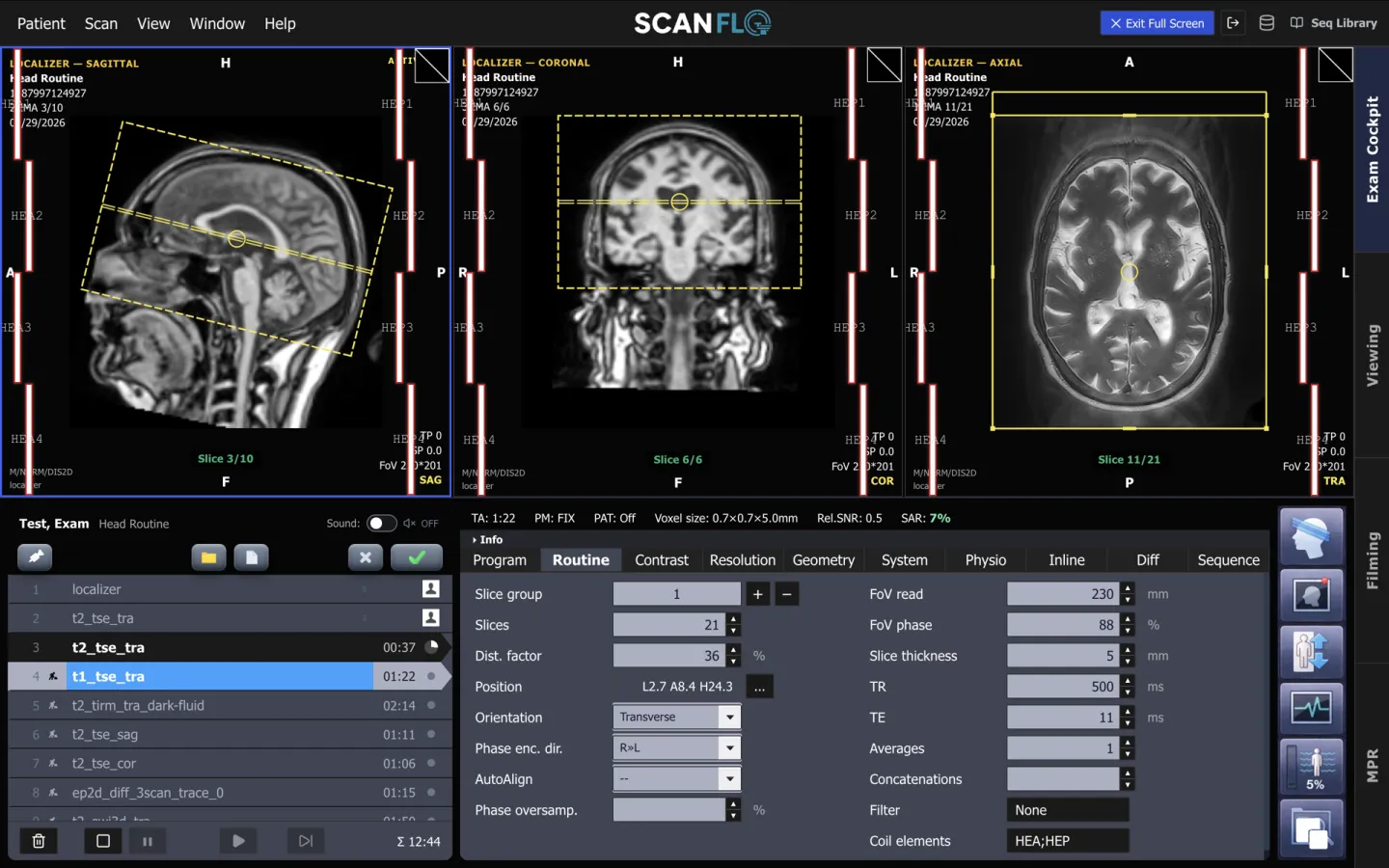
Plan brain, spine and knee on real localizers in ScanFlo MRI, change TR and TE, and fix the artefacts you will be asked about.
Start free →Related: TR and TE at the console, knee and musculoskeletal protocols, and hands-on MRI practice before your first posting.
Sources
Every figure in this article links back to one of these.
- American College of Radiology. ACR Manual on MR Safety, 2024
- MHRA. Safety guidelines for magnetic resonance imaging equipment in clinical use, fifth edition, July 2026
- American College of Radiology. ACR Manual on Contrast Media
- American College of Radiology. Management of acute reactions to contrast media in adults (reaction card)
- Elster AD. Image contrast: TR and TE. MRIquestions.com
- Elster AD. Wrap-around artifact. MRIquestions.com
- Elster AD. Chemical shift artifact. MRIquestions.com
- Chien A, Weaver JS, Kinne E, et al. Magnetic resonance imaging of the knee. Polish Journal of Radiology, 2020;85:e509-31
- AIIMS Raipur. Skill test notice, Radiographic Technician Grade I, 2018
- AuntMinnie. ACR launches updated manual on MRI safety
- Society of Radiographers. Ace that job interview, 2018
Frequently asked questions
Is the 5-gauss line still the right answer?
Mention both. The 5-gauss line is what older textbooks teach. The ACR's 2024 manual endorses the IEC standard that uses the 9-gauss line to define the static field hazard area, and the FDA recognises it. Saying that shows you are current.
Can pregnant patients have MRI?
Yes, when the clinical need justifies it, with the scanner kept in Normal operating mode for SAR. MHRA guidance notes that the IEC advises limiting pregnant patients to Normal mode when using the whole-body transmit coil. Whether to give gadolinium in pregnancy is a radiologist's decision under department policy.
Do patients need to fast before MRI contrast?
Not for routine intravenous contrast, according to the ACR Manual on Contrast Media. Some exams, such as MRCP, have their own preparation, so check the protocol.
What should a fresher with no MRI experience say?
Be honest about the posting you had, then show method: describe how you screened patients, which protocols you watched and what you practised on a simulator. Interviewers hire people who know what they don't know and how they will learn it.
What questions should I ask at the end?
Ask about MR safety training for new staff, which scanners and field strengths they run, how the roster splits MRI and CT, and who signs off your competencies. Good questions show you have thought about the job as well as the offer.