
Building a radiography lab on a budget: simulators vs scanner hours
ScanFlo Editorial Team · · 8 min read
In this article
- What does a radiography skills lab need to teach?
- What does AERB require before a college runs an energised X-ray room?
- What does an MRI or CT scanner cost?
- Why are borrowed scanner hours so hard to get?
- Phantoms, VR or software: what do you get for the money?
- What does a three-tier budget lab look like?
- How do you justify the spend to management?
A radiography lab on a budget starts with what needs no beam: a non-energised positioning room, role-play, and software simulators for MRI, CT and X-ray. Phantoms come next. Real scanner hours, the most expensive resource, are kept for short capstone sessions once students are already competent at the console.
Principals usually start from the wrong question: which scanner can we afford? The better question is which skills need a scanner at all. The answer is fewer than you might think.
What does a radiography skills lab need to teach?
Positioning, exposure choices, radiation protection, patient care, image evaluation and, for MRI and CT, planning and parameters. Only some of these need a live beam.
| Skill | Role-play room | Phantom | Software simulator | Real scanner |
|---|---|---|---|---|
| Patient communication | Yes | No | No | Yes |
| X-ray positioning | Yes | Yes | Yes (virtual patient) | Yes |
| Exposure factors and image quality | No | Yes | Yes | Yes |
| MRI planning and parameters | No | No | Yes | Yes |
| CT protocols, contrast timing and dose | No | No | Yes | Yes |
| Artefact recognition and fixes | No | Some | Yes | Yes |
| Safety screening | Yes | No | Some | Yes |
Simulation can be modest and still useful. The University of Bradford's report for the College of Radiographers notes that medium and low fidelity simulation may be appropriate for some learning outcomes and reduce some of the financial barriers
(Bradford, 2025). Even ARRT, for its radiography competencies, describes simulation as using proper radiographic equipment without activating the x-ray beam
(ARRT).
What does AERB require before a college runs an energised X-ray room?
Type-approved equipment bought with procurement permission, a shielded room, an operating licence, and students who operate only under direct supervision.
Room size matters too. AERB's 2001 code set a minimum of 18 m² for a general radiography room and 25 m² for a CT gantry room, with no side shorter than 4 m (AERB, 2001). That code has since been superseded, so treat those numbers as a planning starting point and check the current layout guidance.
What does an MRI or CT scanner cost?
A new 1.5T MRI costs ₹6–9 crore according to trade press. The bigger surprise is what it costs to keep running.
Cheaper machines may be coming. Prof. Rama Jayasundar of AIIMS Delhi told ThePrint that India's first indigenous MRI could reduce expenses for MRI by 40–50 percent
, quoting the director general of SAMEER (ThePrint, 2025). Even at half the price, a teaching-only scanner is a hard case to make.
| Item | Reported cost | Source |
|---|---|---|
| X-ray positioning phantom | About $31,000 (US) | SUNY Orange funding request |
| University X-ray teaching suite, UK | About £250,000 (2017) | Society of Radiographers |
| MRI scanner bought in 2007, India | ₹5.86 crore | Health, 2013 |
| New 1.5T MRI, India | ₹6–9 crore | The Indian Practitioner, 2025 |
Why are borrowed scanner hours so hard to get?
Because every teaching slot is a paid study the hospital gives up. The government's own rate for an MRI brain is ₹2,500.
CGHS reimburses ₹2,500 for an MRI brain and ₹1,035 for a plain CT head at NABH-accredited centres (CGHS rate revision, 2023). Private rates are often higher. A department that hands a college an afternoon on the MRI is giving up several of those, which is why the slots shrink every time the patient list grows.
Phantoms, VR or software: what do you get for the money?
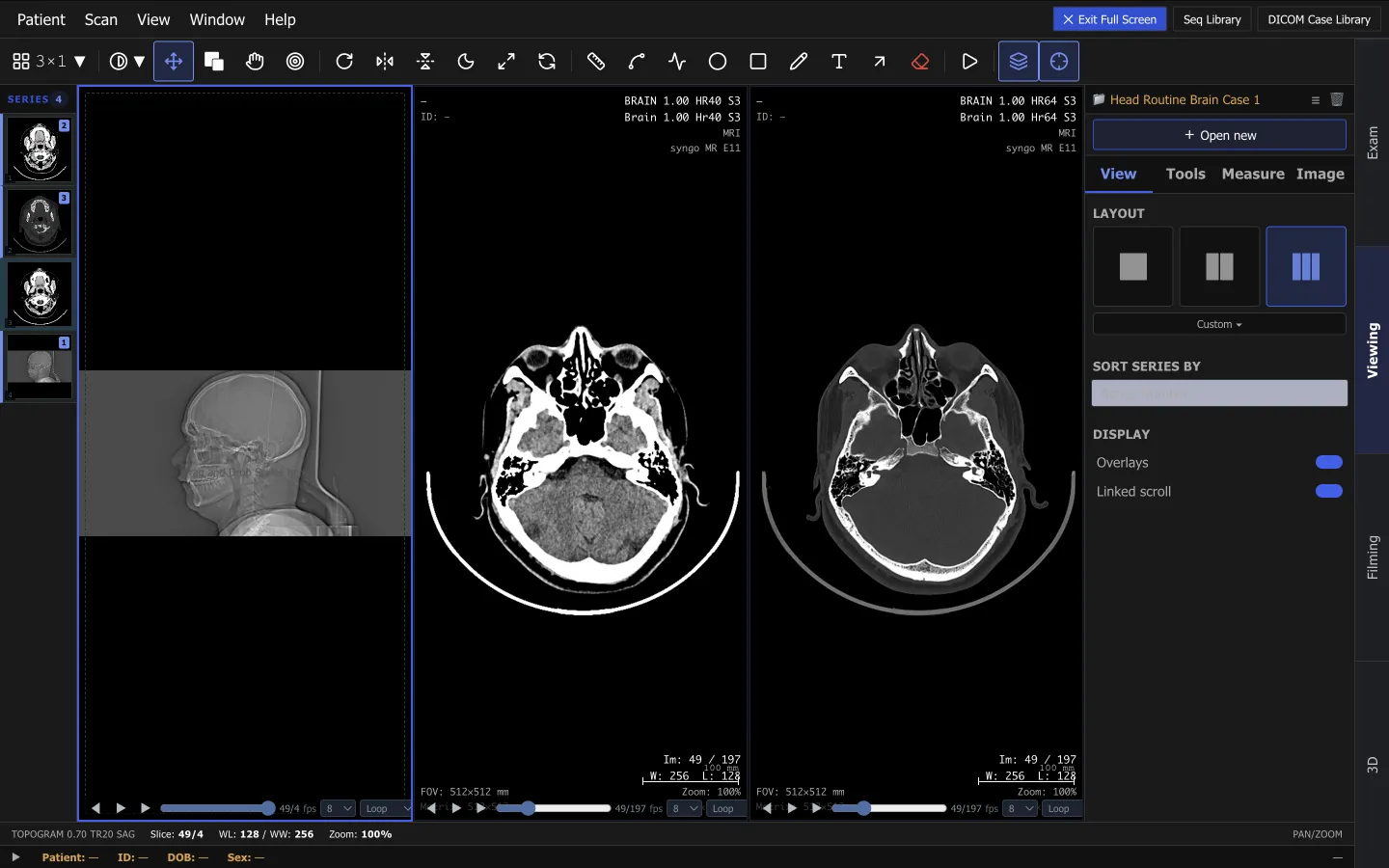
Phantoms teach real exposures to one student at a time. VR and software simulators scale to a whole batch, and software covers MRI and CT, which phantoms cannot.
For positioning, VR has some evidence behind it. In a study of 188 first-year students in South America, the VR group finished its OSCE faster and made fewer positioning and equipment-handling errors than students trained on physical simulation, although exposure errors did not differ (Rowe and colleagues, Journal of Medical Radiation Sciences, 2023). For MRI and CT the skills are console decisions, and a browser simulator runs on the lab computers you already own.
What does a three-tier budget lab look like?
Tier one is a positioning room and software simulators. Tier two adds phantoms. Tier three is negotiated scanner time for capstone sessions.
How do you justify the spend to management?
Tie each purchase to a curriculum outcome, and measure the result with OSCE stations.
The NCAHP competency-based MRIT curriculum asks institutes to provide simulation and skill labs for practicing skills specific to the program
(NCAHP curriculum, Gurugram University edition). That line, plus pre- and post-test scores from your own students, is a stronger case than any brochure. Our guides on teaching MRI without scanner time and on objective skills assessment cover the teaching and measuring side.
Try it on the console
Equip the whole batch, not one bay
ScanFlo runs MRI, CT and PET-CT consoles in the browser on the computers you already have, with faculty assignments built in.
See ScanFlo for institutes →Related: the radiography simulation guide and X-ray and radiography simulators.
Sources
Every figure in this article links back to one of these.
- Atomic Energy Regulatory Board. Safety code for medical diagnostic X-ray equipment and installations, AERB/RF-MED/SC-3 (Rev. 2)
- Atomic Energy Regulatory Board. Regulatory requirements and guidelines for upcoming radiology facility
- Atomic Energy Regulatory Board. Safety code AERB/SC/MED-2 (Rev. 1), 2001 (superseded)
- The Indian Practitioner. India's first indigenous MRI machine set to reduce scan costs
- ThePrint. Story behind India's 1st indigenous MRI machine, that could make scans more affordable, March 2025
- Unit cost of CT scan and MRI at a large tertiary care teaching hospital in North India. Health, 2013;5(12)
- CGHS. Revision of rates of 36 radiological imaging investigations, 2023
- Society of Radiographers. Derby University welcomes SoR president to the opening of new high tech imaging suites, January 2017
- SUNY Orange. Purchase X-ray anatomical phantom for positioning, funding request
- Wilkinson E, et al. The role and efficacy of simulation in pre-registration education and training of diagnostic radiographers. University of Bradford, 2025
- ARRT. Radiography didactic and clinical competency requirements
- Rowe D, Garcia A, Rossi B. Comparison of virtual reality and physical simulation training in first-year radiography students in South America. Journal of Medical Radiation Sciences, 2023;70(2)
- NCAHP competency-based curriculum, Bachelor of Medical Radiology and Imaging Technology (Gurugram University edition)
Frequently asked questions
Does a college X-ray room need its own Radiological Safety Officer?
An energised X-ray installation is licensed by AERB and needs an RSO and personnel monitoring like any other facility. A non-energised room used only for positioning practice does not expose anyone, but check with AERB or an RSO before you rely on that distinction.
Do refurbished scanners make sense for teaching?
Sometimes, for a college attached to a hospital that will also scan patients on them. For teaching alone, the purchase, licence, shielding and maintenance contract usually cost far more than software simulators that every student can use at once.
Can students practise MRI safety screening without a magnet?
Yes. Screening is a structured conversation and a form. Students can role-play it in any classroom, then practise planning and parameters on an MRI simulator.
How many students can share one simulator?
With browser-based software, each student uses their own login on any lab computer or laptop, so a whole batch can practise at once. Phantoms and VR headsets are shared and need a rota.
Is VR better than role-play for positioning?
One study of 188 first-year students in South America found the VR group finished its OSCE faster with fewer positioning errors. Both have a place: VR for repetition, role-play with a real person for communication and touch.