
PET quantification
SUVmax, MTV, TLG and the references that give them meaning.
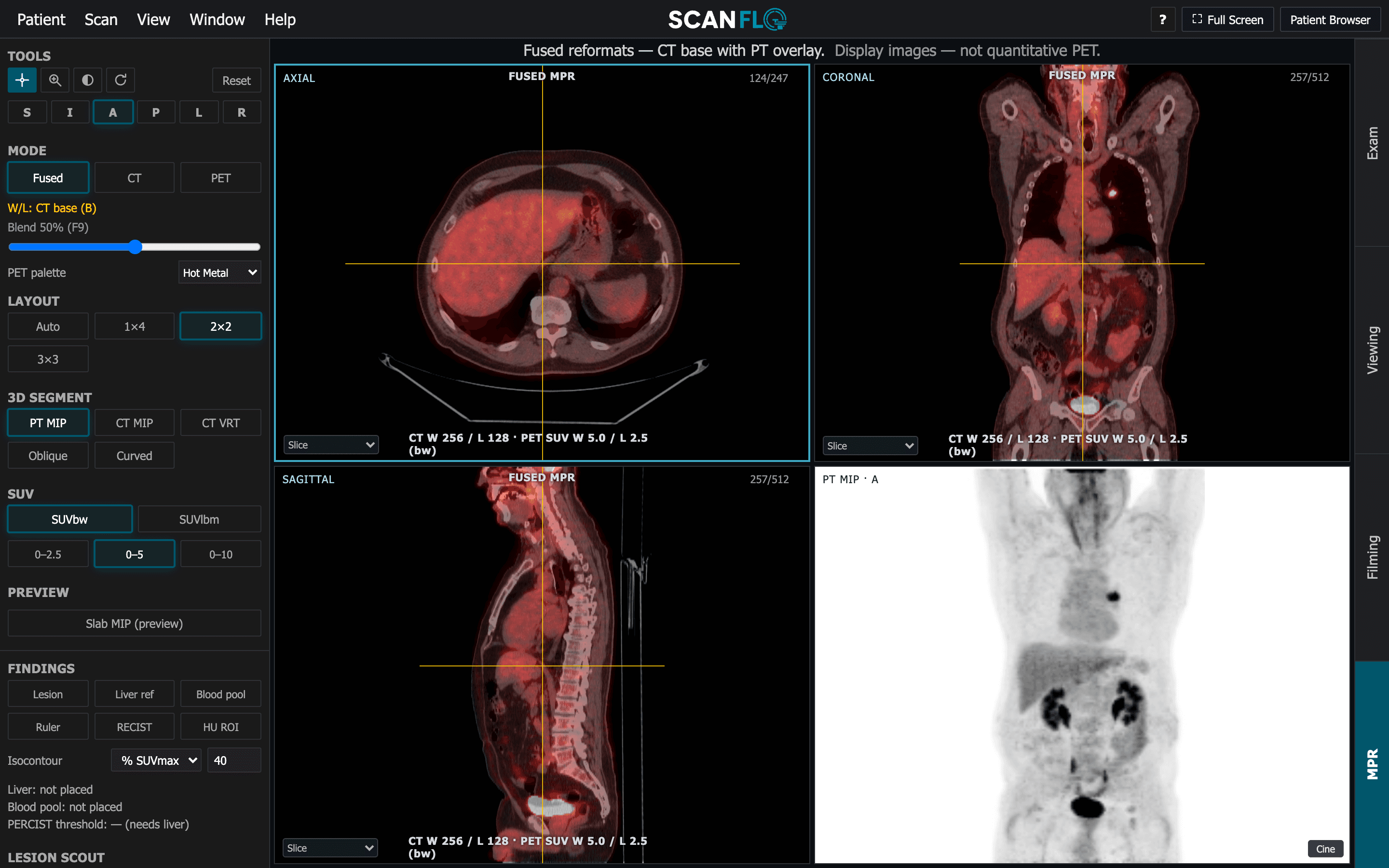
VOI quantification with SUVmax, SUVmean, SUVpeak, metabolic tumour volume and total lesion glycolysis. Liver and blood-pool references drive the PERCIST threshold and Deauville scoring, with Lesion Scout, RECIST and HU ROI measurements and timepoint comparison.
How it works
Three steps, on a real console workflow.
Place the references
Put the liver and blood-pool references; the PERCIST threshold is computed from the liver.
Measure the lesions
Draw a VOI with a percent-of-SUVmax isocontour and read SUVmax, SUVmean, SUVpeak, MTV and TLG. Lesion Scout helps find candidates; RECIST and HU ROI measure on the CT.
Compare timepoints
Open a second timepoint and compare the same lesions. That is the response question a follow-up PET-CT answers.
What gets measured
| Measure | From | What it teaches |
|---|---|---|
| SUVmax, SUVmean, SUVpeak | The lesion VOI | Why SUVpeak is steadier than SUVmax |
| MTV and TLG | Isocontour volume × SUVmean | The whole burden of disease, beyond the hottest voxel |
| PERCIST threshold, Deauville | Liver and blood-pool references | Reading uptake against the patient's own background |
| RECIST, HU ROI | The CT | Anatomical response beside metabolic response |
In the classroom
How programs use it
- Measure the same lesion at 40% and 50% isocontours and discuss how MTV and TLG move.
- Score a lymphoma study with Deauville from the liver and blood-pool references.
- Compare two timepoints and write a PERCIST-style response line.
Learn the concepts
Short guides that pair with this feature:
Start today
Put your learners at the console today.
Free 45-minute trial. No installs. Runs in any browser.